How to read an automated security finding
A short framework for judging evidence, confidence and the next action in a web security report.

By Luca Deguin
A long list of alerts is not the same as a useful security report. The question is what each alert actually proves. A clear finding lets you trace an observation to a conclusion and decide whether to fix, reproduce or investigate it.
Read the observation before the severity
Start with the request, the response and the conditions under which the result appeared. Did the scanner observe a behavior that exposes data or bypasses a control? Or did it infer risk from a header, a route name or a configuration hint? Those are different levels of evidence.
Severity describes potential impact. Confidence describes how strongly the available evidence supports the conclusion. A high impact hypothesis can still have low confidence. The report should make that difference visible.
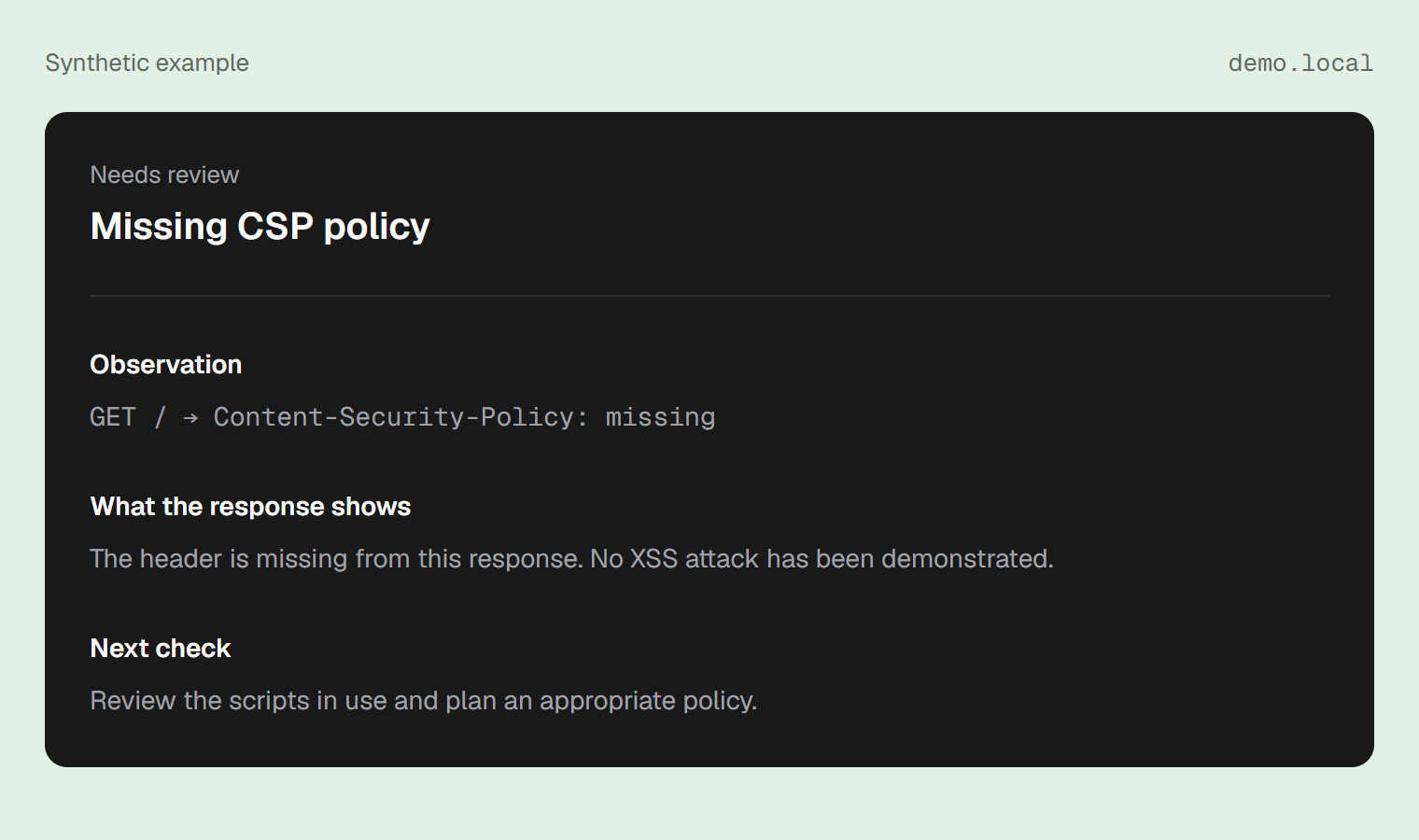
Synthetic example. The missing header is an observation; an exploitable XSS issue has not been demonstrated.
Choose the next action from the evidence
A confirmed result deserves a reproducible fix path. A probable result may need a targeted manual check. A heuristic is a prompt to inspect a specific configuration or behavior. Informational observations can help explain the system without becoming vulnerabilities by default.
For example, a public route is not automatically an access control failure. The decisive question is whether that route returns data the current user should not see. Likewise, a missing defensive header may be a hardening opportunity without proving an exploitable attack.
Preserve enough context for a human
A useful report names the affected surface, explains the security consequence and gives a safe way to reproduce the result. It should also state uncertainty plainly. Screenshots and raw responses can help, but they should not expose tokens, personal data or other secrets to everyone who opens the report.
Automated testing is valuable because it repeats checks consistently. Human review still matters when the meaning of a response depends on application behavior, authorization rules or business context.
The best first question for any alert is simple: what did the tool observe, and what does that observation prove? From there, prioritize the confirmed risks, verify the plausible ones and treat the rest as context. VICE uses this evidence first approach in its open source engine and platform reports.